
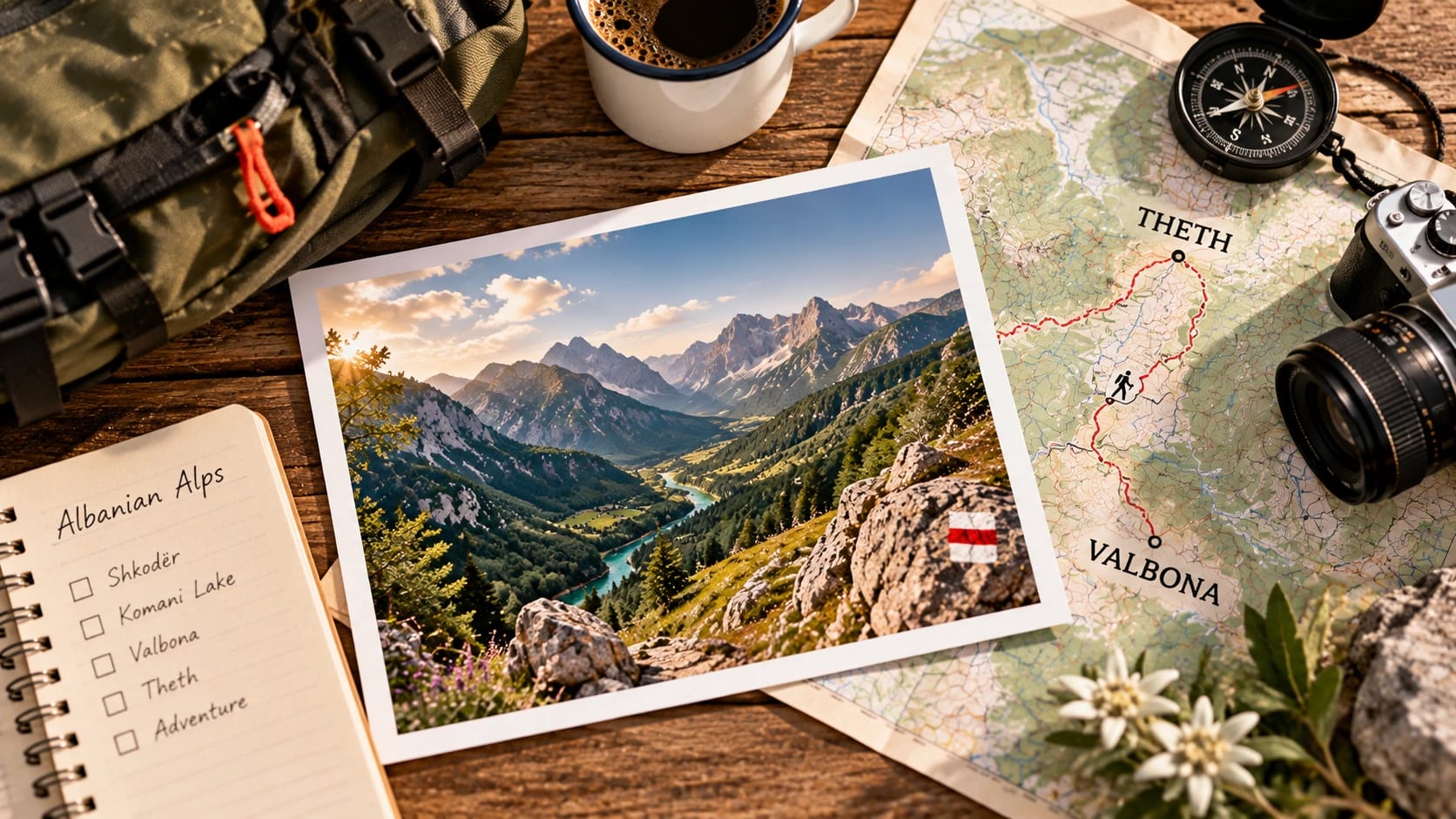
Hiking
Theth and Valbona: A Hiking Guide to the Albanian Alps
Emma ThompsonJul 16, 202616 min read
Of everything I get asked about Albania, nothing comes up more often than this hike. Not the beaches, not Tirana, not the visa rules — the Theth-to-Valbona crossing, or its reverse, is the single trip every serious traveler seems to have already heard about before they've even landed, and for good reason. It's become the signature outdoor experience of northern Albania, the kind of day that shows up in trip reports and photo dumps more than almost anything else in the country. So instead of my usual approach, I'm going to try to actually answer everything here — every question I've fielded about this hike over the years, in one place, in enough detail that you shouldn't need to go digging anywhere else before you go.
01What This Hike Actually Is
Theth and Valbona are two remote mountain valleys in Albania's far north, part of the Albanian Alps, also called the Accursed Mountains (Bjeshkët e Nemuna), a range that spills across the borders into Montenegro and Kosovo. Each valley has its own small village, its own guesthouses, its own version of stunning, and between them runs a single-day hiking trail over Valbona Pass that's become one of the most iconic treks in the Balkans. Most people do it in one direction — starting in whichever village they arrived in and finishing in the other — rather than as an out-and-back, which is also how I'd recommend doing it.
02Distance, Elevation, and Time — The Real Numbers
Depending on exactly where you start and finish, the trail runs somewhere between about 14 and 18 kilometers point to point — the shorter figure if you start from Rrogam, a small settlement above Valbona village, the longer one if you're going trailhead to trailhead through the full valley floors. Elevation ranges from around 800 meters at the valley floors up to roughly 1,800 meters at the top of Valbona Pass itself, which is the trail's only real climb — everything else is a gradual valley walk on either side of it.
For time, budget 7 to 8 hours for a comfortable, unrushed pace with a proper lunch break at the top, where a small seasonal drinks stand usually sets up in summer to sell you a coffee with what might be the best view of your entire trip. Fast, fit hikers can do it in 4 to 5 hours; slower groups, or anyone stopping constantly for photos, which I fully endorse, might take closer to 9 or 10. I'd call the difficulty solidly moderate — nothing technical, no exposure that requires real climbing skill, but the climb to the pass is steep enough in sections, and the descent afterward long enough, that you'll feel it in your knees the next day regardless of how fit you are.
03Do You Need a Guide?
Honestly, no, not in good weather and daylight — the trail is very well marked with red-and-white paint flashes roughly every 50 meters, and the path itself, a pale, rocky track, is easy to follow even where it narrows. I've hiked it solo, with friends, and once with a group that included someone doing their first serious hike ever, and none of us needed a guide to find the way. That said, I'd genuinely reconsider going without one if you're hiking outside peak season, if the weather forecast looks unstable, or if you're simply someone who prefers company and local knowledge on a remote trail with no phone signal — guesthouses on both ends can arrange a local guide for you with a day or two's notice, and it's money I've never heard anyone regret spending.
04When to Go
The hiking season runs roughly May through October, with snow lingering at the pass into May in a heavier winter, and the first serious snowfall typically closing the route again sometime in November. The most reliable window, weather-wise, is mid-June through September. July and August are the busiest months by a wide margin — genuinely busy by this trail's standards, though nowhere near as crowded as a hike this good would be almost anywhere else in Europe — so if your schedule allows it, I'd steer toward June or September for a quieter trail and equally good conditions. Whatever month you go, check the forecast the night before and the morning of; heavy rain turns sections of this trail genuinely unpleasant and occasionally unsafe, and it's not a route to push through in a storm.
05How to Get There: Two Very Different Ways In
This is the part of the trip that trips up more people than the hike itself, so let me walk through it properly. There are two main ways to reach Theth or Valbona, and the best plan, if you can manage it, is to use one on the way in and the other on the way out, turning the whole trip into a loop instead of a there-and-back.
The first option is the direct road route to Theth: a minivan or furgon from Shkodra, taking roughly two and a half to three hours over a mountain road that's been substantially improved in recent years but still climbs and winds enough to make it a memorable ride on its own, including a stretch through Thethi National Park's forested switchbacks. This is the more straightforward option if your priority is simply getting to the start of the trail with the least fuss.
The second option, and the one I actually recommend building your trip around if you have the extra day, is the Komani Lake ferry. This is a genuinely spectacular boat ride through a flooded river canyon that looks more like a Norwegian fjord than anything you'd expect in the Balkans, running between Koman and Fierza. The ferry (operated by Ferry Berisha) currently runs daily from mid-April to early November, departing Koman around 9am and Fierza around 1pm, taking roughly two to three hours depending on stops. A one-way ticket runs about €9 to €10 per person. To reach the Koman side, minivans run from Shkodra at around 6:45am (about €8) and from Tirana at around 5:30am (about €12); on the Fierza side, connecting minibuses run on to Valbona village, with departures typically around midday and again in the afternoon, for roughly €8. All of these times shift slightly by season, so I'd always confirm the current schedule locally or through your guesthouse a day or two before you travel, rather than treating any timetable, including this one, as fixed in stone.
Put together, my favorite version of this trip looks like this: bus from Shkodra to Koman early in the morning, the ferry across to Fierza, a connecting minibus on to Valbona village to sleep, the full day's hike over the pass to Theth the next day, a night in Theth, and then the direct minivan back down to Shkodra to close the loop. It's a genuinely full two or three days, and every leg of it, not just the hike itself, ends up being part of the story people tell afterward.
06Where to Stay
Both valleys run on small, family-owned guesthouses rather than hotels, almost all offering half-board — a bed plus dinner and breakfast — for a genuinely modest price, typically somewhere in the €25 to €35 per person range depending on the season and the house. Meals are often served family-style, whatever the household cooked that day, and I've had some of the best simple home cooking of my entire time in Albania at guesthouse tables in both villages. Well-regarded, frequently recommended options include Guesthouse Mehmeti on the Valbona side and Guesthouse Marashi in Theth, though there are plenty of good alternatives in both villages and asking your host on one side for a recommendation on the other is a perfectly reliable way to book your next night. In July and August, book at least a couple of weeks ahead if you can; the villages are small, rooms are limited, and this hike's popularity has outpaced the number of beds more than once in peak season.
“Every single person I've sent over that pass has come back changed in the same specific way — a little sunburnt, a little sore, and completely unable to stop talking about it.”
07What Else to See Beyond the Trail Itself
Don't treat this as a straight hike-in, hike-out trip if you can help it, because both valleys have their own worthwhile detours. In Theth, the short walk out to Grunas Waterfall, about two kilometers south of the village through the dramatic Grunas Canyon, drops roughly 25 to 30 meters down a moss-covered rock face into a genuinely cold pool that's very tempting after a hot day, and the round trip takes about two to three hours if you linger. Theth's small stone church, built around 1892, with its shingled bell tower and conical roof sitting alone in the green valley floor, is the single most photographed building in the region and worth the short walk even if you're not usually a church-photographing kind of traveler.
The one I find myself explaining to almost everyone, though, is the Kulla e Ngujimit, the Lock-in Tower, a stone structure in Theth that ties directly back to the old Kanun tradition I've written about elsewhere on this site — the historical code that, among other things, governed blood feuds in this part of the country. This tower was where men caught up in an active feud could confine themselves for safety, sometimes for months or years, rather than be killed in retaliation outside its walls. It's a small, humbling museum today, and standing inside it does more to explain that whole strange, heavy piece of Albanian highland history than any amount of reading about it beforehand. On the Valbona side, the old stone bridges over the Valbona river and the sheer scale of the valley walls, some of the tallest and most dramatic in the Accursed Mountains, are worth a slow wander on their own, especially in the golden light of early evening once the day-hikers have cleared out.
08What to Pack
- A refillable water bottle — natural springs along the trail mean you rarely need to carry more than a liter or two at a time.
- Layers, including a light waterproof or windproof jacket — mountain weather here changes fast, even in summer.
- Sun protection: hat, sunscreen, sunglasses, especially for the exposed climb near the pass.
- Snacks or energy food for the trail; there's very little to buy en route beyond the seasonal drinks stand at the top.
- Comfortable, broken-in trail shoes or light hiking boots — full mountaineering boots aren't necessary, but flat sandals are a genuinely bad idea.
- Cash in lek — cards are essentially useless in both villages, and you'll need cash for guesthouses, meals, and any local guide.
- A portable power bank — there's no reliable power or signal on the trail, and guesthouse charging can be limited.
- As light a bag as you can manage; if you're staying multiple nights and don't want to carry everything, ask about porter or luggage-transfer options through your guesthouse, or simply leave a larger bag at your hotel in Shkodra before you head up.
09Safety, Signal, and a Few Realities Worth Knowing
There is no reliable mobile signal for most of the hike between the two valleys, and WiFi exists only at guesthouses, so treat this as genuinely off-grid time and plan accordingly, including telling someone your route and expected arrival time before you set out. The mountains here are home to brown bears, wolves, and lynx, though actual encounters are rare and none of my own trips, or those of anyone I've hiked with, have involved so much as a distant sighting — staying on the marked trail and avoiding hiking alone in the very early morning or at dusk is sound practice regardless. I'd also gently discourage solo hiking here in general, less because of wildlife and more because of the practical reality of a twisted ankle on a remote trail with no signal to call for help; hiking with at least one other person is the simple, sensible fix.
If One Day Isn't Enough: The Peaks of the Balkans
For hikers who fall for this landscape and want more of it, the Theth-Valbona crossing is actually just one leg of a much longer route called the Peaks of the Balkans, a roughly 200-kilometer circular trail through the Prokletije mountains that weaves across the borders of Albania, Montenegro, and Kosovo over about ten days, with shorter seven-day and longer eleven-day variations available. It's a genuinely serious undertaking that requires border permits from all three countries, applied for at least two weeks in advance with your exact crossing dates, times, and locations specified — free in Albania and Kosovo, with a fee in Montenegro. It's not something to improvise; most people either go through a local operator who handles the permit process, or invest real time well ahead of their trip putting the paperwork together themselves. But if the single day between Theth and Valbona leaves you wanting more, this is where that feeling leads.
What It All Costs, Roughly
Putting the whole trip together: the Komani Lake ferry runs about €9 to €10 one way, connecting minibuses on either side generally run €8 to €12 per leg, guesthouse half-board runs roughly €25 to €35 per person per night, and a local guide, if you want one, is typically arranged through your guesthouse for a modest daily fee on top of that. All told, a two or three day loop covering both valleys, the ferry, the hike, and two nights of guesthouse half-board comes out remarkably reasonable for what is, by any measure, one of the more memorable two or three days you can spend in the Balkans.
10The Questions I Get Asked Most
Is the Theth to Valbona hike hard? It's moderate — no technical climbing, but a real, sustained climb to the pass and a long descent afterward, so reasonable fitness helps, especially for the final stretch into either village.
Can I do this hike without a guide? Yes, in good weather and daylight the trail is clearly marked and easy to follow. A guide becomes more worthwhile outside peak season, in uncertain weather, or simply for the local knowledge and company.
Which direction should I hike, Theth to Valbona or Valbona to Theth? Both directions are equally valid and see roughly equal traffic; I'd let your transport logistics decide, since the Komani Lake ferry naturally feeds into Valbona, making a Valbona-to-Theth hike, finishing with the direct road down from Theth, a very clean loop.
Do I need a permit to hike between Theth and Valbona? No — the day hike itself requires no permit. Permits are only needed for the much longer Peaks of the Balkans trail, where the route crosses international borders into Montenegro and Kosovo.
Is there phone signal on the trail? Essentially none for most of the route. Download offline maps beforehand and let your guesthouse hosts know your plans.
When is the best month to hike Theth to Valbona? June and September offer the best balance of stable weather and thinner crowds; July and August are busiest, and the pass can still hold snow into May.
Can beginners do this hike? Reasonably fit beginners generally manage it fine, especially at a slower pace with breaks, though it's a genuinely full day of walking and not a casual stroll — if you're very inexperienced, hiking with a local guide is a sensible extra layer of confidence.
11Why I Keep Sending People Back
I've lost count of how many times I've hiked this trail, and I still find a reason to talk someone into doing it every single season. Part of it is simply the landscape, which does something to first-time visitors that photographs never quite manage to explain in advance. But most of it, honestly, is the whole shape of the trip around the hike itself — the ferry through the canyon, the guesthouse dinner table, the church standing alone in a green valley, the tower with the heavy history inside it. It's not just a good hike. It's one of the most complete single experiences this country has to offer, and if you're only going to do one thing in the Albanian Alps, let it be this.
Travel it with a local team
Tours that cover this
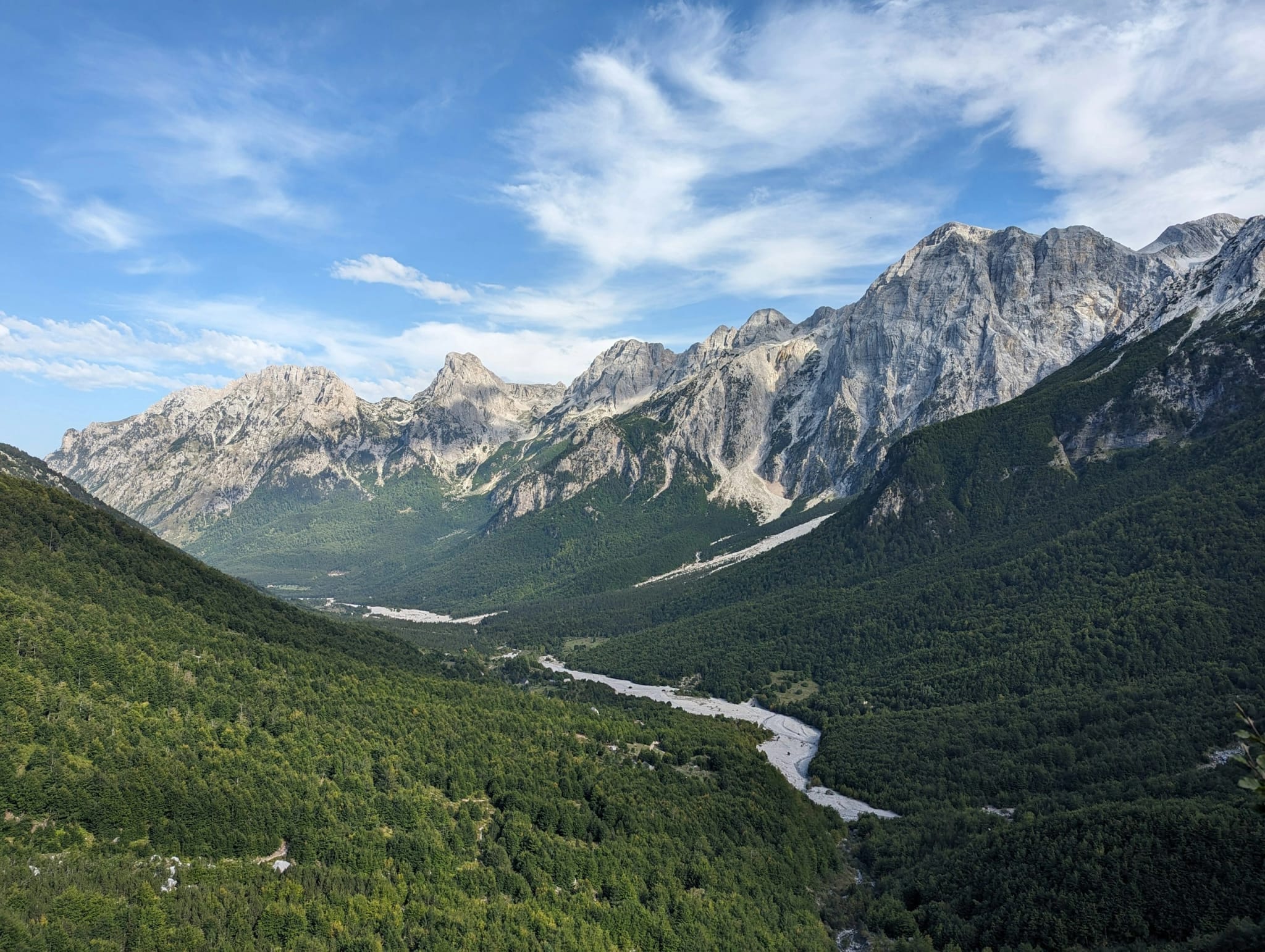
Albanian Alps Hiking Adventure
This six-day hiking journey goes into the heart of the Accursed Mountains (Albanian Alps) in northern Albania. A private boat through the Drin Gorge leads to the Valbona Valley. From there, old shepherd trails climb to viewpoints facing Mount Jezerca, the highest peak in the Albanian Alps.
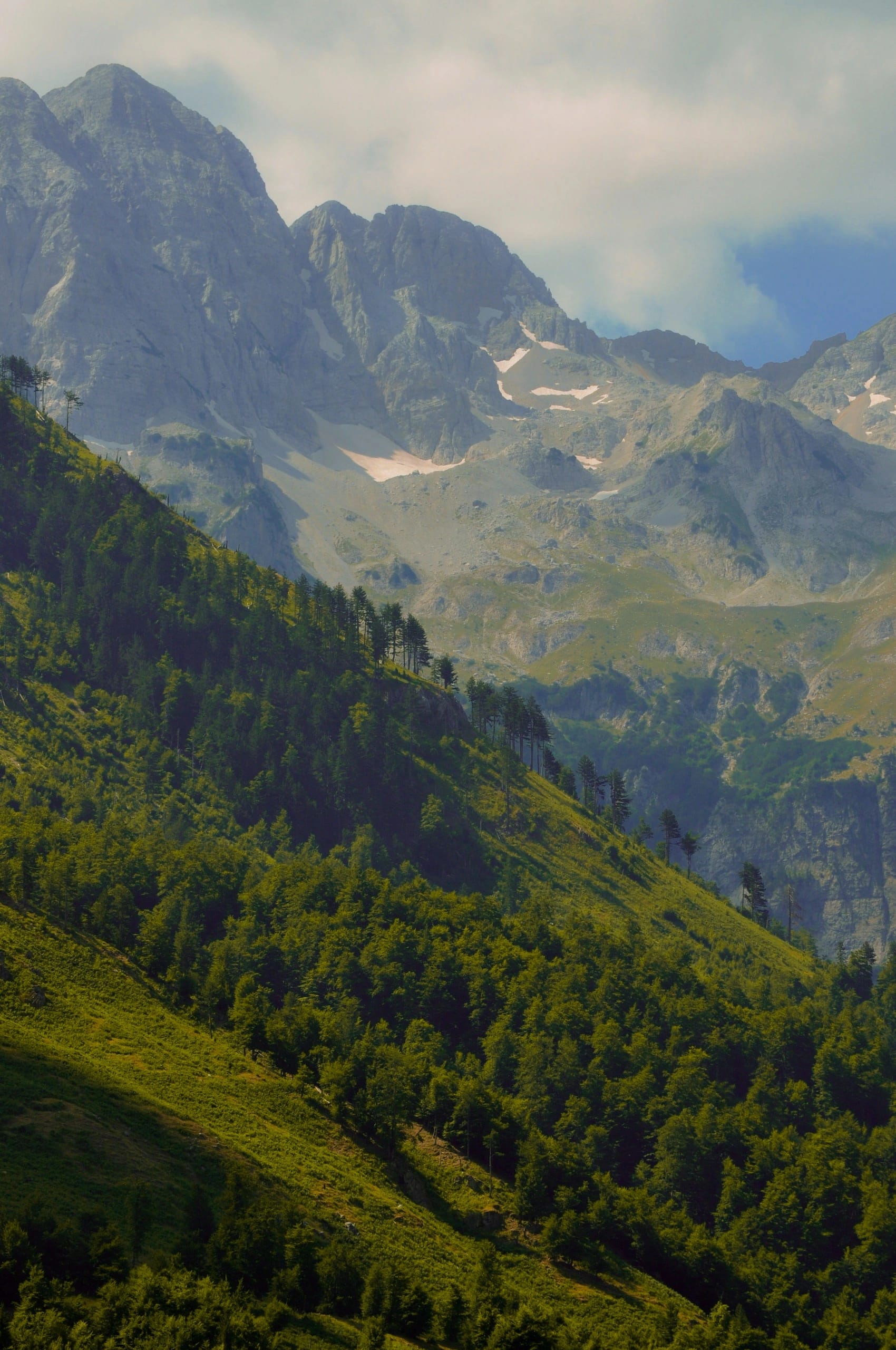
10 Days Hiking Tour
Experience an unforgettable 10-day hiking adventure through Albania’s breathtaking mountains. Summit the country’s highest peak, hike the iconic Valbona–Theth trail, and explore remote alpine villages, national parks, crystal-clear rivers, and spectacular landscapes.
See all upcoming Albania tours or the tours we run on request.

Written by
Emma Thompson
Travel Writer, Co-Travel
Emma has spent years crisscrossing Albania — from Tirana's cafés to the trails of Theth and the coves of the Albanian Riviera — to help travelers see the country the way locals do. She writes first-hand, practical guides for anyone planning their first (or fifth) trip to Albania.
Keep reading
You might also like
 Travel Safety
Is Albania Safe for Tourists? Everything You Need to Know
A first-hand guide to Albania travel safety — real crime data, common scams, driving risks, solo female travel, and the blood-feud myth, from someone who's covered the country corner to corner.
 Trip Planning
Best Time to Visit Albania: A Month-by-Month Guide
Warm sea, open trails, or the cheapest flights — Albania looks different every month. A season-by-season, month-by-month breakdown from someone who's visited in every one of them.
 Visas & Entry Requirements
Do You Need a Visa for Albania? Full Guide by Nationality
A nationality-by-nationality breakdown of who enters visa-free, who needs to apply in advance, and the one rule almost nobody knows about — from a travel writer who's crossed Albania's borders more times than she can count.
 Culture
Albanian Customs and Culture: What to Know Before You Visit
Besa, bottomless coffee, a raki you probably shouldn't refuse, and why nobody here is actually confused about religion — a first-hand guide to the customs that shape daily life in Albania.