
Language
Is English Spoken in Albania? Language and Communication Tips
Emma ThompsonJun 4, 20268 min read
This question comes up in almost every message I get from someone planning a first trip here, usually with a slightly nervous edge to it, as if Albania might turn out to be a place where nobody can understand a word you say. The real answer is more interesting than a simple yes or no, and it has almost everything to do with generation rather than geography.
In Tirana, and especially around Blloku and the main tourist areas, English is close to a given — the capital scores well into the "high proficiency" range on international rankings, menus are routinely printed in both languages, and hotel staff, guides, and younger restaurant servers generally communicate confidently. The same holds along the Riviera, in Sarandë, Ksamil, and the beach towns, where an entire tourism economy has grown up speaking English as a matter of course, and increasingly in Berat, Gjirokastra, and Shkodra too, where young guides and guesthouse owners have picked it up quickly as visitor numbers have climbed. Step outside those zones, though, into smaller villages, rural markets, or the mountains around Theth and Valbona, and English gets genuinely sparse — furgon drivers and village shopkeepers in particular are as likely to speak no English at all as they are to speak some, and a good chunk of the country, by some measures nearly six in ten adults, speaks no foreign language whatsoever.
What actually surprises most visitors, though, is what fills that gap outside the English-fluent zones, and it isn't silence, it's Italian. Ask someone under thirty for directions in Tirana and you'll likely get confident English, absorbed through school curricula that start teaching it from an early age and reinforced by exactly the same shows and platforms travelers grew up on themselves. Ask their grandfather the same question in a smaller town, though, and you're more likely to get Italian, and the reason traces back to the communist era, when ordinary Albanians along the coast quietly rewired their television antennas to pick up Italian broadcasts from across the Adriatic, risking real trouble to do it, simply for access to the outside world. That generation of illegally absorbed RAI television left a whole cohort of Albanians functionally fluent in Italian decades later, which is why I've had more useful conversations in broken Italian with older Albanians than in English, more than once, in towns off the main tourist track. Greek runs a similar pattern in the south, closer to the Greek border and among families with a history of working in Greece, and German has been growing steadily too, carried home by the large Albanian diaspora in Germany and Switzerland.
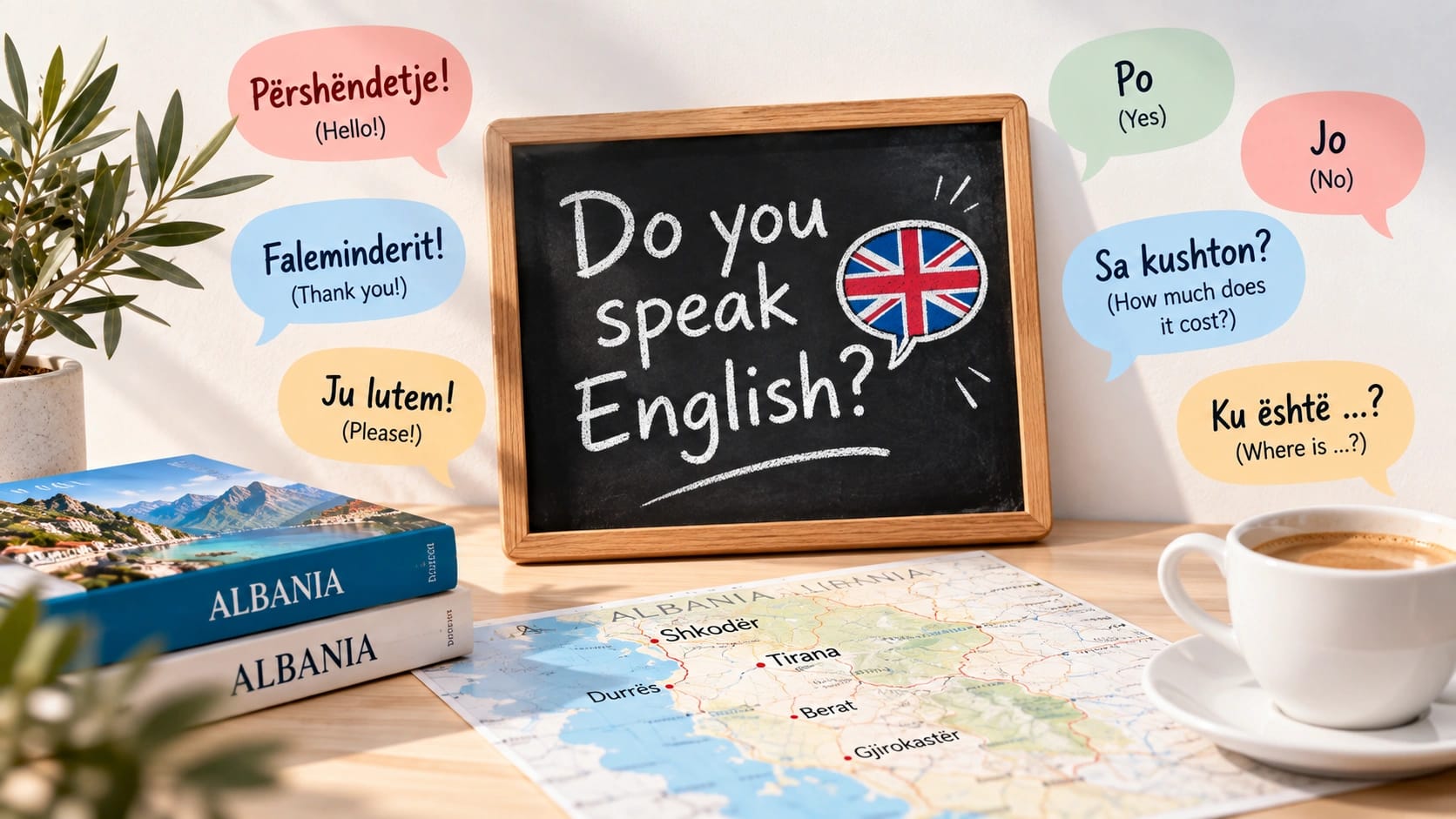
Practically speaking, none of this should worry you much. English gets you through the parts of a trip most visitors spend the most time in — cities, the coast, the well-known historic towns — without real friction, and for the gaps, a handful of Albanian phrases go a genuinely long way, more for the goodwill they generate than the information they convey. "Faleminderit" for thank you, "ju lutem" for please, "sa kushton" for how much does this cost, and "a flisni anglisht" to politely ask whether someone speaks English will cover most situations, and I've watched a shopkeeper's entire demeanor shift after a visitor fumbles through even one of these — Albanians tend to respond warmly, almost disproportionately so, to any real attempt at their language, however imperfect.
“Ask someone under thirty for directions and you'll probably get flawless English, learned partly from school and partly from the same shows you grew up on. Ask their grandfather and you might get Italian instead, learned from a smuggled television signal decades ago.”
One genuinely useful thing to know before you rely on body language to fill in the gaps: the traditional Albanian head gesture for yes and no runs backward from what most visitors expect, a nod up and down historically meaning no, and a side-to-side shake meaning yes. It's a real, well-documented quirk, though I'd flag that it's grown less consistent over the years, especially among younger, urban Albanians who've absorbed the more globally standard gestures through media and travel, so you'll genuinely see both conventions depending on who you're talking to. It's confusing exactly once, usually over something low-stakes like whether a café has a table free, and after that single mix-up most visitors just start double-checking with a spoken yes or no rather than trusting the gesture alone, which is honestly the simplest fix.
If I had to summarize the whole picture, it's this: you will not struggle in the places most first-time visitors actually spend their days, and where you might, in a mountain guesthouse or a rural market, a few memorized phrases, a translation app as backup, and the same patient goodwill Albanians tend to extend to genuine effort will get you through it just fine. I've never once been properly stuck here for lack of a shared language, and neither, as far as I know, has anyone I've traveled with.
Travel it with a local team
Plan this trip with Co-Travel
See all upcoming Albania tours or the tours we run on request.
Written by
Emma Thompson
Travel Writer, Co-Travel
Emma has spent years crisscrossing Albania — from Tirana's cafés to the trails of Theth and the coves of the Albanian Riviera — to help travelers see the country the way locals do. She writes first-hand, practical guides for anyone planning their first (or fifth) trip to Albania.
Keep reading
You might also like
 Travel Safety
Is Albania Safe for Tourists? Everything You Need to Know
A first-hand guide to Albania travel safety — real crime data, common scams, driving risks, solo female travel, and the blood-feud myth, from someone who's covered the country corner to corner.
 Trip Planning
Best Time to Visit Albania: A Month-by-Month Guide
Warm sea, open trails, or the cheapest flights — Albania looks different every month. A season-by-season, month-by-month breakdown from someone who's visited in every one of them.
 Visas & Entry Requirements
Do You Need a Visa for Albania? Full Guide by Nationality
A nationality-by-nationality breakdown of who enters visa-free, who needs to apply in advance, and the one rule almost nobody knows about — from a travel writer who's crossed Albania's borders more times than she can count.
 Culture
Albanian Customs and Culture: What to Know Before You Visit
Besa, bottomless coffee, a raki you probably shouldn't refuse, and why nobody here is actually confused about religion — a first-hand guide to the customs that shape daily life in Albania.