
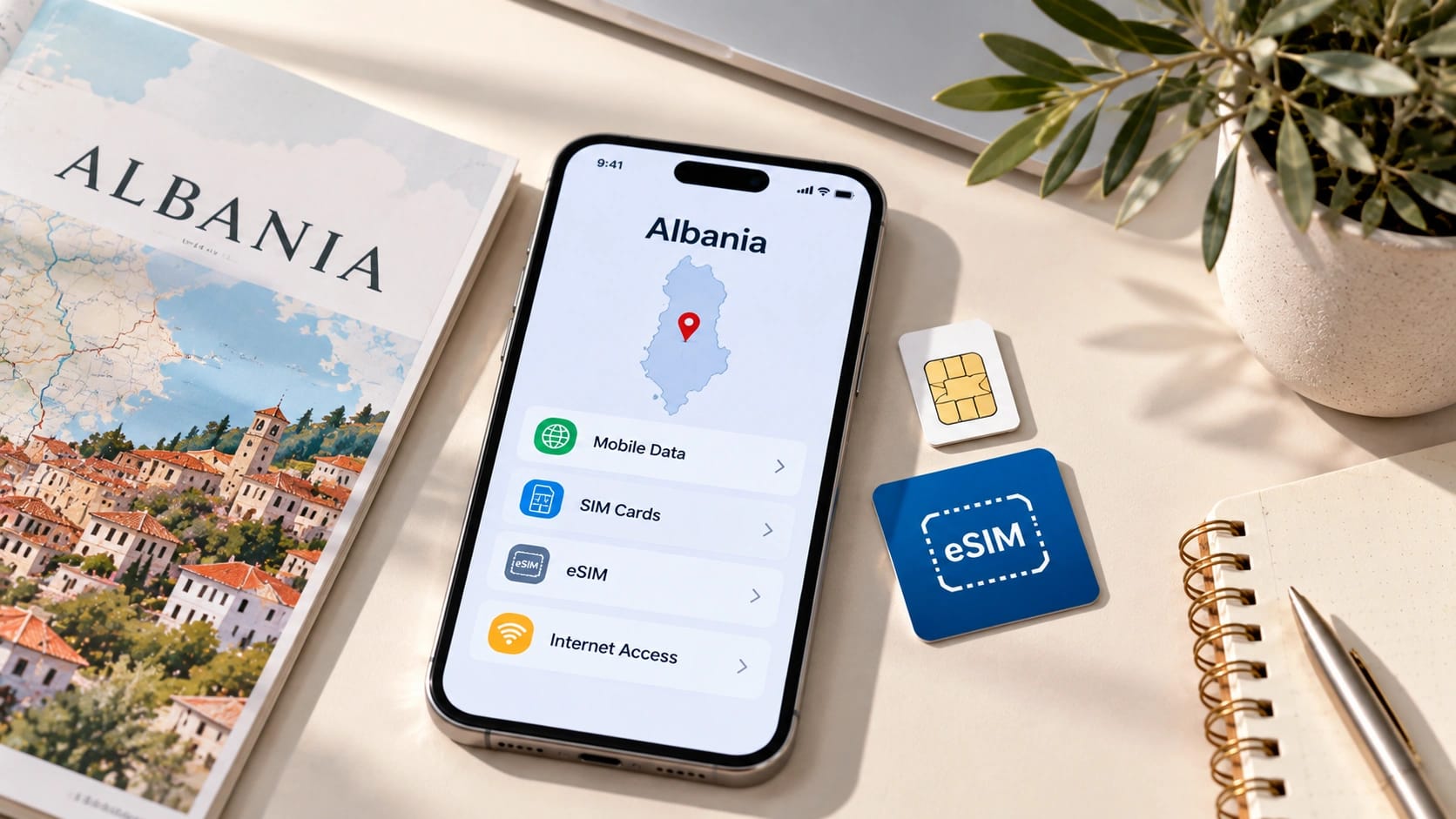
Connectivity
Internet and SIM Cards in Albania: What to Know Before You Go
Emma ThompsonJul 1, 20267 min read
The first thing I tell EU travelers specifically, because it trips up more of them than anyone else, is that Albania is not in the EU, and the "roam like at home" rules that let you use your regular phone plan freely across the bloc simply don't apply the moment you cross the border. I've watched more than one visitor realize this only after checking a very unpleasant roaming bill partway through their trip, so it's worth sorting out before you land rather than after. The good news is that getting a local SIM is easy, cheap, and quick almost everywhere. Albania has three main carriers worth knowing: Vodafone Albania, part of the global Vodafone network; ONE; and ALBtelecom. All three sell tourist-friendly prepaid packages running roughly €6 to €9 for a week with several gigabytes of data, or €12 to €18 for a month with considerably more, and the price differences between them are small enough that convenience matters more than shaving a euro or two off the total. Every operator requires passport registration to activate a SIM, a straightforward process that takes maybe 15 to 30 minutes at a shop, and Vodafone runs a dedicated counter right in the arrivals hall at Tirana airport with English-speaking staff, which makes it the obvious choice if you want to walk off the plane and be online within the hour.
Where the carriers actually start to differ is coverage outside the cities, and this matters more than people expect if any part of your trip heads into the mountains. In Tirana, along the coast, and in the main tourist towns, all three networks perform well with solid 4G. But if Theth, Valbona, or anywhere else in the Albanian Alps is on your itinerary, Vodafone is consistently the better bet — by most accounts the only carrier with genuinely usable signal at altitude, where ONE and ALBtelecom tend to thin out or disappear entirely. I'd still temper expectations even with Vodafone, though: the hiking trail between Theth and Valbona itself has essentially no reliable signal on any network, so treat that stretch as properly off-grid regardless of which SIM is in your phone, and lean on guesthouse WiFi at either end instead.
If you'd rather skip the SIM shop entirely, an eSIM is a genuinely good option for a lot of travelers now, especially anyone with a phone that supports it. You can buy and activate an eSIM plan before you even leave home, which means landing already connected instead of hunting for a counter or a shop on your first tired afternoon, and it sidesteps the passport-registration step entirely. The trade-off is that eSIM data plans tend to be priced a bit higher than a local prepaid SIM for the equivalent amount of data, and if you specifically need the strongest possible signal in the mountains, a physical Vodafone SIM is still the safer bet over a generic eSIM provider that may be routing through a different underlying network. My honest approach these days is a hybrid one: an eSIM for the first day or two of connectivity while I settle in, and a proper local SIM, usually Vodafone if I know I'm heading north, once I've had a chance to sort it out properly in a shop.
“If Theth or Valbona is anywhere on your itinerary, the carrier you pick matters more than the price difference between them ever will.”
WiFi, separately, is genuinely reliable in the places you'd expect — hotels, guesthouses, and cafés in cities and tourist towns almost universally offer it, often with a password printed right on the menu or the receipt without you even having to ask. It gets patchier the further you get from those hubs, particularly in smaller mountain guesthouses where a single router is doing a lot of work for a whole house full of guests, so I wouldn't plan on a video call from deep in the Alps even with WiFi technically available.
Put simply: sort out data before you need it rather than after, know that your home EU plan won't quietly cover you here, and if the mountains are part of the plan, let that decide your carrier rather than the few euros of difference in the price. Everything else about staying connected in Albania is about as easy as it gets.
Travel it with a local team
Plan this trip with Co-Travel
See all upcoming Albania tours or the tours we run on request.

Written by
Emma Thompson
Travel Writer, Co-Travel
Emma has spent years crisscrossing Albania — from Tirana's cafés to the trails of Theth and the coves of the Albanian Riviera — to help travelers see the country the way locals do. She writes first-hand, practical guides for anyone planning their first (or fifth) trip to Albania.
Keep reading
You might also like
 Travel Safety
Is Albania Safe for Tourists? Everything You Need to Know
A first-hand guide to Albania travel safety — real crime data, common scams, driving risks, solo female travel, and the blood-feud myth, from someone who's covered the country corner to corner.
 Trip Planning
Best Time to Visit Albania: A Month-by-Month Guide
Warm sea, open trails, or the cheapest flights — Albania looks different every month. A season-by-season, month-by-month breakdown from someone who's visited in every one of them.
 Visas & Entry Requirements
Do You Need a Visa for Albania? Full Guide by Nationality
A nationality-by-nationality breakdown of who enters visa-free, who needs to apply in advance, and the one rule almost nobody knows about — from a travel writer who's crossed Albania's borders more times than she can count.
 Culture
Albanian Customs and Culture: What to Know Before You Visit
Besa, bottomless coffee, a raki you probably shouldn't refuse, and why nobody here is actually confused about religion — a first-hand guide to the customs that shape daily life in Albania.