
Culture
Complete Tirana Travel Guide: What to Do in the Capital
Emma ThompsonMar 30, 202610 min read
The first thing I tell people about Tirana is that it doesn't behave the way capital cities are supposed to. It's small enough to walk across in an afternoon and confusing enough to get pleasantly lost in for a week. I remember my first morning here, years ago now, ordering a coffee at a café that turned out to be one of roughly four hundred within a few blocks of my hotel, sitting at a metal table on a sidewalk that used to be sealed off entirely from ordinary Albanians, and thinking that no single walk through this city was going to make sense of it. That turned out to be exactly right, and also exactly the point.
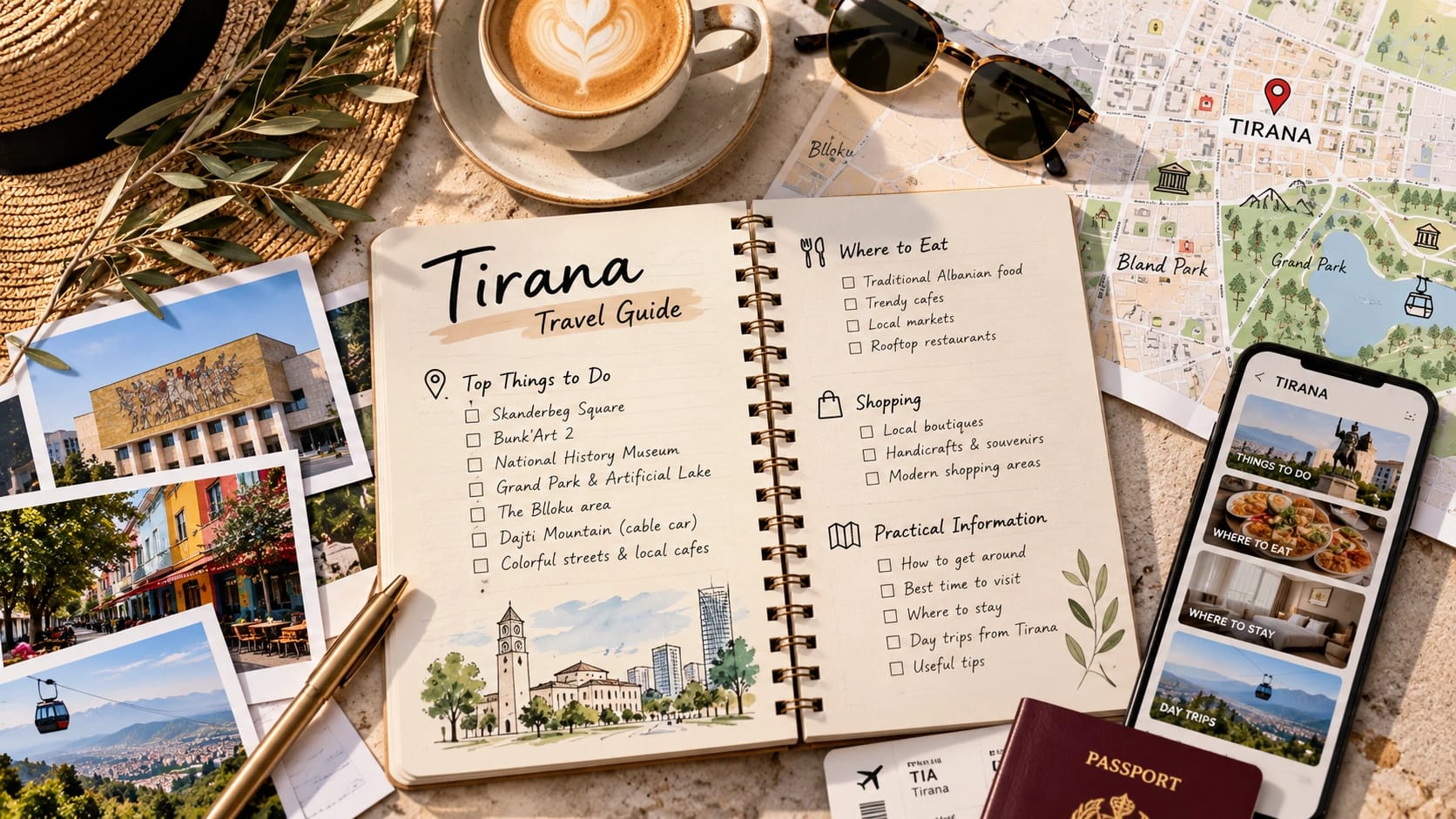
Start where everyone starts, because it genuinely is the heart of the place: Skanderbeg Square, an enormous stone plaza redone a few years back with stone quarried from every Albanian-speaking region, which sounds like a small detail until you're standing on it and realize the whole country basically contributed a piece of the ground under your feet. The equestrian statue of Skanderbeg himself, Albania's fifteenth-century national hero, watches over a ring of buildings that between them tell you most of what you need to know about this place — the National History Museum with its enormous socialist-realist mosaic on the façade, the Ottoman-era Et'hem Bey Mosque, the old clock tower, an opera house, a national bank. Come back in the evening, once the fountains are lit and half the city seems to have wandered out for an evening walk with everyone else, and the square makes a different kind of sense than it does at ten in the morning. Duck into Et'hem Bey Mosque while you're there, even if you only have ten minutes, which is genuinely all it takes. It's an eighteenth-century building that survived both the regime's decades-long ban on religion and the general neglect that followed, reopening properly again only recently, and the interior frescoes are unlike any mosque decoration I've seen elsewhere — waterfalls, bridges, trees, painted in a style that feels almost more folk art than religious. Remove your shoes, dress modestly, and give yourself a moment in there before you're back out in the square's noise.
From the square, walk northeast for a few minutes and you land in Pazari i Ri, the New Bazaar, which I genuinely think is one of the best things to have happened to this city in the last decade. In the morning it's produce stalls and spice vendors and old men arguing cheerfully over the price of cheese; by evening the same square turns into a dense cluster of restaurants and bars doing serious, unpretentious Albanian food, without a single tourist menu in sight. I've eaten some of my favorite meals in this country at plastic tables here, more than once staying long past when I meant to leave.
Somewhere in the same walk, you'll notice the buildings start doing something unusual — blocks of drab Soviet-style apartment housing suddenly interrupted by facades painted in bright oranges, yellows, and geometric patterns, like someone took a paintbrush to the whole neighborhood. That's not accidental, and it's one of my favorite pieces of Tirana trivia: a former mayor of this city, an artist by training before he became a politician, started painting the gray communist-era blocks in bold colors in the early 2000s, partly as public art and partly as a genuine, almost stubborn act of civic optimism. It worked well enough that it's now one of the things people photograph most without fully knowing the story behind it, and I like telling people the story precisely because it explains something true about how this city thinks of itself.
Not far past the bazaar sits the Pyramid, and if you only have energy for one strange, photogenic stop in Tirana, make it this one. It was built in 1988 to glorify the dictator Enver Hoxha, spent decades afterward as a half-abandoned, graffiti-covered ruin that locals climbed for fun and outsiders photographed as a kind of accidental monument to the fall of communism, and has since been fully restored into TUMO Tirana, a free tech and creative education center for young people. You can still climb the exterior walkways to the top, for free, for what might be the best view in the city for the actual cost of ten minutes of effort, and there's something quietly satisfying about a monument built to celebrate one man now belonging, literally, to teenagers learning to code.
“Tirana doesn't explain itself in one glance. You have to walk it, sit in it, order one more coffee than you meant to, before the city stops feeling like contradictions and starts feeling like one place.”
If the Pyramid is Tirana being playful about its past, Bunk'Art and the House of Leaves are the city being honest about it, and I'd genuinely set aside real time for at least one of them. Bunk'Art 1, a five-story Cold War bunker dug into a hillside on the city's edge, walks you through Albanian history from Italian occupation through the end of communism in 1991, including the dictator's own private quarters and unflinching exhibits on the internment camps that defined so much of that era — plan two or three unhurried hours for it. Bunk'Art 2, smaller and closer to Skanderbeg Square, narrows in specifically on the Sigurimi, the secret police, and somehow lands even harder emotionally despite being the shorter visit. The House of Leaves, the former Sigurimi surveillance headquarters itself, does something similar in miniature — an hour is enough, but it's an hour that tends to stay with people, full of personal informant files with names redacted and the quiet, procedural detail of how an entire population was watched.
By late afternoon, I usually point people up rather than further across the city: the Dajti Ekspres cable car lifts you out of Tirana in about fifteen minutes to roughly 1,600 meters, and on a clear day the view stretches out across the whole plain toward the Adriatic. There's a restaurant at the top, some walking trails, even a small adventure park if you've got kids or restless energy left, but mostly I go up there for the simple physical relief of being above the city rather than inside it for an hour, and for how the light changes right around sunset if you time the ride for late afternoon.
And then, because Tirana genuinely does save its best trick for last, there's Blloku — the neighborhood that used to be sealed off entirely to the Communist Party's own leadership, walled away from the ordinary residents of the city it sat inside. Today it's the loudest, most caffeinated, most alive few blocks in the country, and it runs on a rhythm I've come to find oddly comforting: cafés holding court until around five, dinner tables filling from seven to ten, bars taking over from ten until around one, and then whatever's left of the night belonging to the clubs. Thursdays tend to belong to locals before the weekend crowd arrives, and the dress code, such as it is, skews a little more polished than you might expect from a neighborhood with this much history of being off-limits. I've had some of my best nights out anywhere in the Balkans on these particular streets, which still strikes me as a strange and pretty wonderful thing for a place that, within living memory, ordinary Albanians weren't allowed to walk through at all.
People often ask me how many days Tirana actually deserves, expecting me to say one, because that's the reputation it has among travelers rushing toward the coast or the mountains. I usually tell them two, minimum, and privately think three is better — not because there's an overwhelming checklist to get through, there really isn't, but because this is a city that rewards the version of travel where you let an afternoon run long, order the second coffee you didn't plan on, and let the contradictions sit next to each other instead of trying to resolve them into a single tidy impression.
That's the real Tirana, as far as I've ever been able to tell after all these years of coming back to it — not one thing, but all of these things at once, somehow working.
Travel it with a local team
Tours that cover this
See all upcoming Albania tours or the tours we run on request.
Written by
Emma Thompson
Travel Writer, Co-Travel
Emma has spent years crisscrossing Albania — from Tirana's cafés to the trails of Theth and the coves of the Albanian Riviera — to help travelers see the country the way locals do. She writes first-hand, practical guides for anyone planning their first (or fifth) trip to Albania.
Keep reading
You might also like
 Travel Safety
Is Albania Safe for Tourists? Everything You Need to Know
A first-hand guide to Albania travel safety — real crime data, common scams, driving risks, solo female travel, and the blood-feud myth, from someone who's covered the country corner to corner.
 Trip Planning
Best Time to Visit Albania: A Month-by-Month Guide
Warm sea, open trails, or the cheapest flights — Albania looks different every month. A season-by-season, month-by-month breakdown from someone who's visited in every one of them.
 Visas & Entry Requirements
Do You Need a Visa for Albania? Full Guide by Nationality
A nationality-by-nationality breakdown of who enters visa-free, who needs to apply in advance, and the one rule almost nobody knows about — from a travel writer who's crossed Albania's borders more times than she can count.
 Culture
Albanian Customs and Culture: What to Know Before You Visit
Besa, bottomless coffee, a raki you probably shouldn't refuse, and why nobody here is actually confused about religion — a first-hand guide to the customs that shape daily life in Albania.